

Pranayama (breath work)
Pranayama begins with a simple question:
Why is breath so important?
Unlike most functions of the body, breath exists between worlds.
It is automatic, yet voluntary. Unconscious, yet accessible.
Ancient yogis recognized something remarkable: changing the breath changes experience itself.
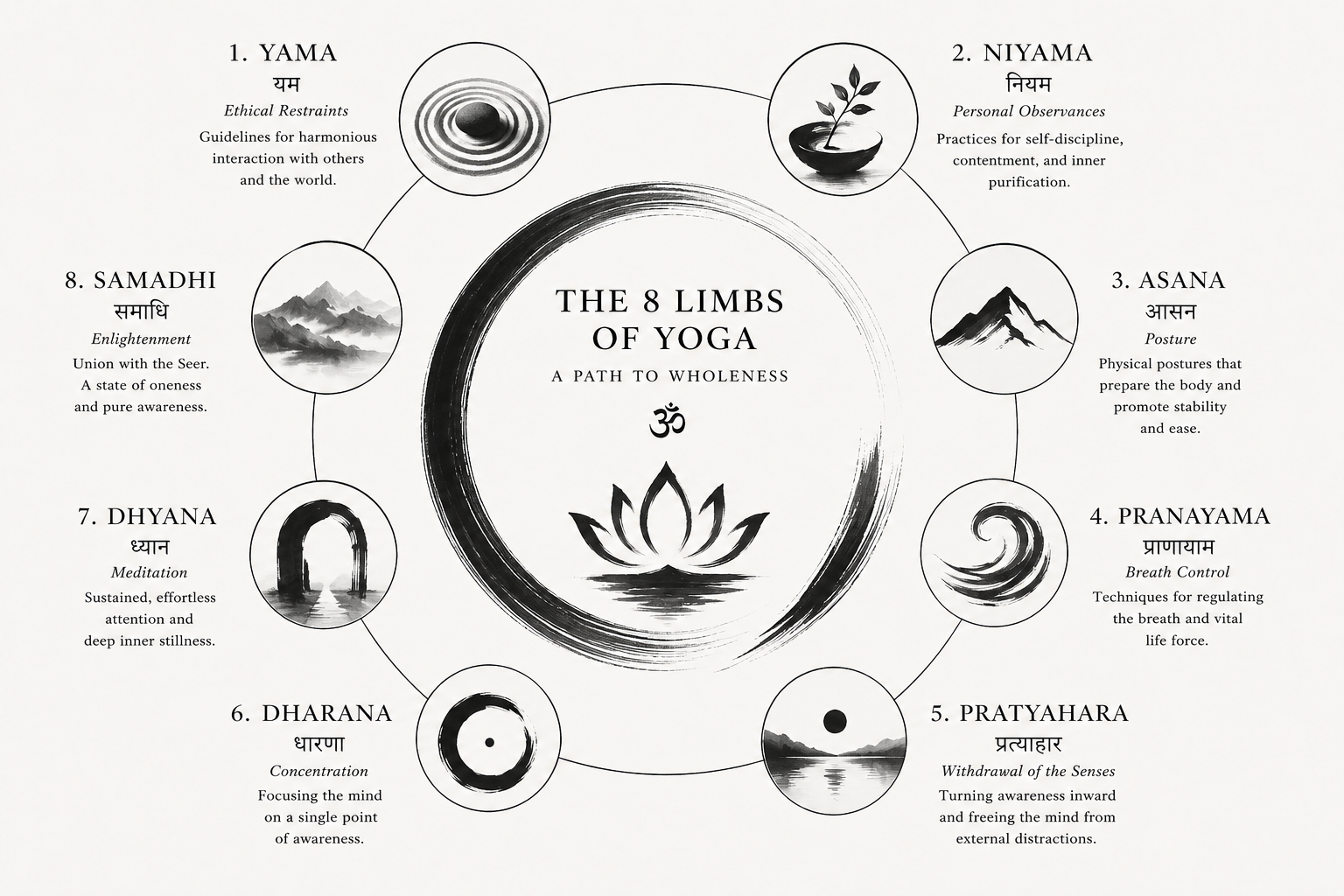
Long before neuroscience, they observed that breath influences attention, emotion, energy, focus, perception, and states of consciousness. Modern science increasingly agrees. Breath affects heart rate variability, vagal tone, nervous system regulation, stress response, attention, and emotional processing.
Yet pranayama was never intended solely as a relaxation technique.
It was designed as preparation.
Preparation for deeper awareness. Preparation for meditation. Preparation for understanding the nature of mind itself.
How often nature returns to the same patterns. The branching of our lungs, tree limbs, roots, neurons all resemble each other. Galaxies, whirlpools, Jupiter’s storms, smoke. Flower petals growing in Fibonacci sequences and spirals found throughout nature.
Again and again, reality seems to organize itself through relationship, repetition, and pattern. Whether this reflects efficiency, mathematics, emergence, or something deeper, I find it difficult not to be humbled by it. Nature appears less like a collection of separate objects and more like an ongoing conversation of patterns, relationships, and processes unfolding across different scales.
Fractals within fractals.
The breath participates in this rhythm. Every inhale connects us to the atmosphere that sustains all life. Every exhale returns something back. The boundary between self and world becomes harder to define than we often imagine.
Pranayama explores that relationship consciously.
Through techniques such as Nadi Shodhana, Ujjayi, Bhramari, Sama Vritti, Sheetali, and Kumbhaka, practitioners learn to influence the quality of attention itself.
As the breath steadies, awareness begins to gather. In yoga, this transition is called Pratyahara, the withdrawal of the senses. Not because the world disappears. But because attention is no longer pulled in every direction at once.
The mind becomes quieter.
Concentration becomes possible.
Meditation emerges naturally.
Pranayama is a beautiful technique to bridge us into Pratyahara. One breath. One moment of awareness. One step deeper into the mystery of being alive.