

Yoga/asana practice
Yoga is one of the world’s oldest living spiritual traditions/religions, originating in India thousands of years ago. While many people in the modern West encounter yoga through physical postures and exercise classes, traditional yoga was always intended as something much broader: a path of self-study, liberation, presence, and union.
The word yoga itself is often translated as “to yoke” or “to unite”, bringing together body and mind, self and world, awareness and experience.
The movement, flexibility, strength, and balance are beautiful expressions of the practice, but they are only one small part of something much older and much deeper. In traditional yogic philosophy, the physical postures, the asanas, are only one of the eight limbs of yoga.
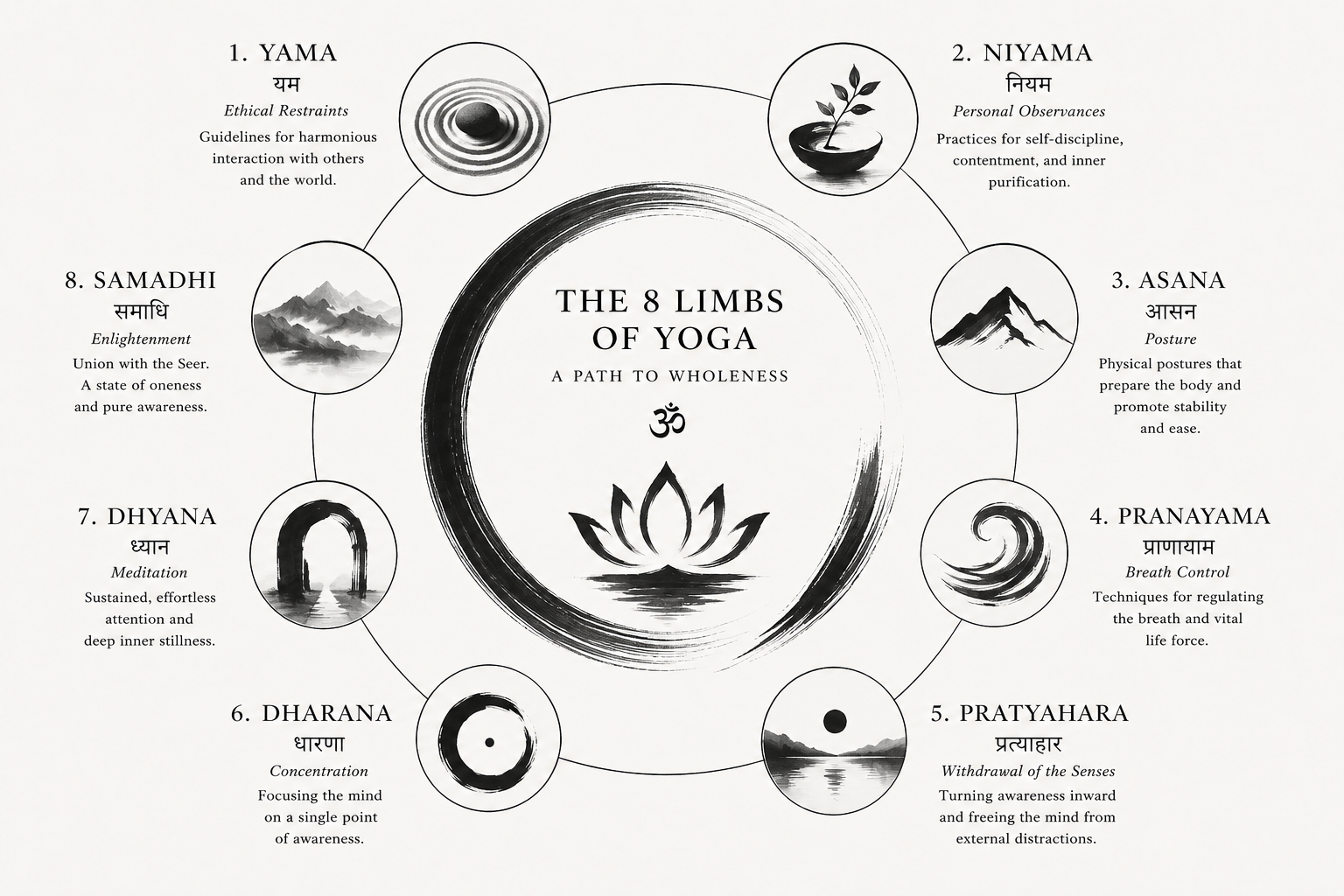
At its core, asana practice feels like a relationship between awareness and embodiment.
It asks a simple but profound question:
What happens when we fully arrive inside ourselves?
Modern culture often teaches us to override the body. Push harder. Ignore pain. Disconnect. Dissociate. Perform. Achieve.
Asana practice invited me in a different direction:
To listen.
To breathe.
To notice.
What fascinates me is how physical experiences and emotional experiences mirror one another. Learning to breathe steadily through physical discomfort can slowly teach us how to remain present through emotional discomfort too.
The breath becomes a bridge between the body and the mind.
People often imagine spirituality as transcending the body, but asana practice taught me that the body itself is sacred. Not because it is perfect. Not because it looks a certain way. Simply because it is the vessel through which we experience life.
Breath is sacred.
Presence is sacred.
Attention is sacred.
The nervous system changes when we slow down enough to truly inhabit ourselves.
Science supports many of the asana’s physiological benefits: stress reduction, mobility, circulation, vagal tone, breath regulation, and parasympathetic activation.
But beyond the measurable effects, there is also something experiential that becomes difficult to reduce into purely clinical language.
A kind of remembering.
Not perfection.
Not performance.
Not enlightenment.
Just connection.
Connection to breath.
To sensation.
To grief.
To joy.
To stillness.
To community.
To being alive.
I do not believe asana practice is about becoming more flexible than everyone else or performing spirituality aesthetically.
I think the asanas are a practice of returning.
Again and again.
To yourself.